Monday, July 21, 2008

DID THE BUSH ADMINSTRATION BANKROLL THE DARK KNIGHT?


Up next: Waterboarding


In The Dark Knight, Batman seeks to protect the world from terrorists and suicide bombers.

But evildoers like the Joker don't play by the rules. So Batman, who has always operated outside of the law, must become even more vigilante and take measures with which even his own staff is uncomfortable.

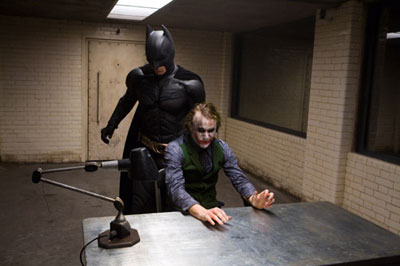
And so Batman wiretaps all of Gotham's citizens' cell phones. He listens to their conversations to infiltrate terrorist cells. When the Joker is in custody, he resorts to violent interrogation techniques that rise to the level of torture. Not only does he refuse to listen to authorities, he doesn't even stay for the end of conversations. Batman is The Decider.

As Bruce Wayne, Batman also embeds himself in the shady worlds of cronyism and money laundering. His company secretly funds defense contractors and top secret weapons research. He calls upon his rich friends to support men like Harvey Dent who take tough stances on crime. The fundraising is especially important to offset the influence of the Chinese, who are literally sitting on top of our money.

As the film progresses, Batman's approval rating with the citizens of Gotham City begins to tank, in light of the rising death toll of Gotham's soldiers. But the film makes clear to the viewer that Batman was only acting for the greater good.

Which leads to the question that serves as the title of this post: Did the Bush Administration bankroll The Dark Knight?

The movie is well-crafted and undoubtedly entertaining. (To my surprise, Heath Ledger really does give an Oscar-worthy performance.)

But TDK is also a powerful propaganda film that ultimately justifies Bush's actions in his global War on Terror.

Intentional or not, the Nolan brothers clearly support the use of torture and other unlawful custodial interrogation techniques in times of terror. The film climaxes with multiple "ticking time bombs," which is the exact scenario that GOP Congressional leaders and other pundits have cited when defending the need to torture. The sadistic criminal refusing to leak life-saving information is both at the apex of TDK and at the core of why this country hasn't passed more laws banning the use of torture.

Plus, if Congress had any trouble passing the FISA bill, they could have delayed the vote until after this film, which showcases the need for eavesdropping and glorifies other temporary deprivations of civil liberties to fight the bad guys.

As if the allusions to the current administration's policies were not obvious enough, by the end of the film, Harvey Dent even looks like Dick Cheney blew the left side of his face off.

A movie that reflects our post-9/11 world? Nothing new.

But a post-9/11 film that actually seems to unabashedly endorse Bush's post-9/11 response? New to me.

Perhaps the only point that the analogy fails is when we see Batman actually struggle with the moral complexities and ethical constraints of what he's doing.

*

P.S. Since Nolan's version of Batman learned about war in Southeast Asia, perhaps John McCain is a better substitute for The Dark Knight.

(With thanks to Jingalls and Sarisa)

Labels: film, George W. Bush, movies

--Junichi

Permalink | |

Monday, June 02, 2008

A CHAT WITH KEN LEUNG


the ghost whisperer

One more Lost-related post (and a self-plug). I interviewed Ken Leung earlier this spring and among other things, we talked about his role on Lost and how challenging it's been for him given his approach to acting. Leung doesn't do interviews often but I found him to be an exceptionally thoughtful and candid person to talk to. Asian Pacific Arts Magazine has the three-part interview in their new issue.

And here's one of my favorite scenes Leung's done:


Labels: asian american, movies

--O.W.

Permalink | |

Saturday, May 24, 2008

INDIANA JONES AND THE KINGDOM OF THE CRYSTAL MOCKINGBIRD


Snakes. Why did it have to be snakes?


Instead of writing a film review of Indiana Jones and the Kingdom of the Crystal Skull, I've decided to randomly reimagine the plot of To Kill A Mockingbird if the novel had been touched up by the writers of this latest Indiana Jones flick.

Note: Spoiler alert! Seriously, don't read further if you plan on seeing the movie.


To Kill A Mockingbird

Originally written by Harper Lee
Amended by George Lucas and David Koepp


At the height of the Red Scare, Atticus Finch works as a criminal defense attorney in the town of Maycomb, Alabama. After a decade of fighting Nazis, Atticus begins his vigorous defense of an indigent African American defendant named Tom Robinson, who is falsely accused of raping a white woman.

After fleeing a mob of angry townspeople trying to lynch him, Atticus unknowingly wanders into a nuclear testing zone. After leaning on a plastic lawn ornament, he accidentally detonates a nuclear bomb. A second before the blast, Atticus takes refuge in a lead refrigerator. The force of the atomic explosion sends the icebox hurling over the mushroom cloud and safely dumps Atticus back into town.

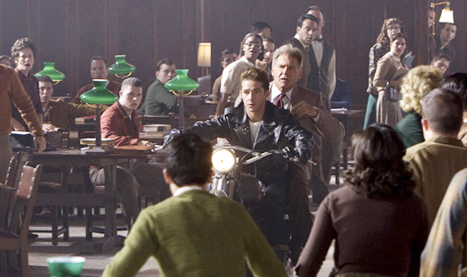
When the leader of the mob - a Russian dominatrix with a quasi-British accent - spots Atticus in a diner, Tom helps them both escape on his motorcycle. At the end of a long pursuit through town, the pair slide underneath a row of tables at the courthouse library. When the motorcycle finally comes to a screeching halt, one of Atticus's other clients calmly asks Atticus if his pretrial motion hearing can be postponed.

Meanwhile, Atticus's children, Jem and Scout, become fascinated by their reclusive neighbor, "Boo" Radley. Scout is so curious about Boo that she makes up stories about him and drops out of school. Unbeknownst to Jem and Scout, Boo leaves the children a gift of a crystal skull. When Scout stares too long into the eyes of the magnetic crystal, she receives secret instructions on how to discover a city of gold.

After Tom's trial, Bob, the alleged rape victim's father, vows revenge upon Atticus. One day, when Atticus picks up Jem and Scout from school, Bob chases them into the Amazonian jungle. After nearly escaping quicksand and blow darts, the Finches escape death when Boo picks them up in an army jeep, uses the crystal skull to ward off flesh-eating ants, drives over a giant cliff, lands on a tree, survives three giant waterfalls, and wards off a tribe of Incan / Mayan / South American / Latino / Indegenous / Hispanic / dark savages.

The Russian Dominatrix also catches up with them, but her plot is yet again foiled when Jem learns to swing on vines like a chimp and leads a barrel of monkeys to stop her.

The plot thickens when Atticus uses his knowledge of Incan hieroglyphics to discover that he is Boo's father.

Finally, when Boo and the Finches discover the path to gold in the city of Akator, Bob attacks again. Jem and Boo kill Bob in self-defense.

When Maycomb's sheriff arrives upon the scene to arrest Jem and Boo, the crystal skull suddenly floats on top of a crystal torso, which is seated in a tribal council of twelve other crystal skeletons. The sheriff decides not to arrest them after the floor becomes a giant spinning wheel of fortune and the skulls form a single extra terrestrial, which converts the Mayan ruin into a giant flying saucer and flies off into space.

After learning that gold is really a metaphor for knowledge, Scout learns that she should stay in school.

The End.

Labels: movies

--Junichi

Permalink | |

Friday, April 25, 2008

THE WAR ON LATINOS GOES TO THE STREETS...LITERALLY


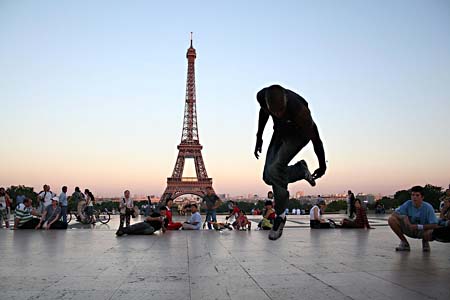
enjoy 'em while they last

Forget Arizona. Right here in Los Angeles, legislators are going after...taco trucks.

$1000 fine or six months in jail for...selling tacos out of a truck? Are you serious? This is what the L.A. City Council considers valuable legislation? Isn't there, for example, low income housing they could focus on? De-congesting traffic? FIXING LAUSD?

Cotdamnit, leave my al pastor alone!

And while you're at it - leave the bacon-wrapped hot dogs be, too.

It's not all bad news...NPR's Morning Edition highlighted the extraordinary story of Guy Gabaldon, a Chicano from East L.A. who learned Japanese from his Issei and Nisei friends growing up and used that skill to convince 1,000 Japanese to surrender during WWII. A new documentary is coming out to tell a story that has gone under the radar for 60 years.

Labels: food, movies, race

--O.W.

Permalink | |

Tuesday, March 25, 2008

DUK DUK GOOSE


beyond redemption?


NPR's All Things Considered picked Long Duk Dong to be part of their "Character Studies" series. (Listen here).

For those of you unaware (read: those of you not born in the 1980s), LDD is pretty much the gold standard in modern f---ed up portrayals of Asian men in Hollywood (Mickey Rooney in yellowface being the older gen's favorite). Everything from the gong that announces his presence, to his accent, to that hair, to, well, everything has traditionally offended Asian Americans to no small degree.

I was just a tad too young to really get into the John Hughes films of the '80s (or maybe I just held little interest in the school/love lives of suburban teens when I was already living it) so I never saw 16 Candles until much later and I have to say...even though I "got" why LDD puts such a black eye on the game, I couldn't help but think he gets a little overvillified.

Don't get me wrong - John Hughes should be thoroughly embarrassed at himself and god knows Gedde Watanabe hasn't had an easy time living down the role but all said, I guess part of me - the Asian geek with insecurity issues - kind of liked how at ease LDD was with himself, how unabashed (read: oblivious) he was in his sense of self. He was a hedonist who didn't really care about what people around him - let alone older White folks - thought of him. He was just trying to do him.

And lest we forget, for all the bemoaning about Asian male asexuality and what not...the Donger got the girl (a white girl at that).

Just putting it out there.

Ok, let's hear it now.

Labels: asian american, movies, race, Untitled

--O.W.

Permalink | |

Friday, February 23, 2007

WHO SHOULD WIN


Not Lost in Translation


I feel surprisingly indifferent about most of this year's Academy Award categories.

As usual, many of my favorite films were shut out altogether from Oscar love: V for Vendetta, Thank You For Smoking, Inside Man, Word Play, Lucky Number Slevin, Hollywoodland, Kiss Kiss Bang Bang, and at the risk of sounding biased, Shut Up and Sing.

I will admit enthusiasm, however, over the fact that 2006 was a relatively good year for racial and ethnic diversity. I'm amazed that eight out of the twenty acting nominees are people of color. I'm also psyched about three Mexican directors being honored for their work.

When Dima and I went to see Babel, we were both amazed to see a film that not only incorporated all four of the languages that we (kinda sorta) collectively speak -- Arabic, Japanese, English, and Spanish -- but also highlighted my penchant for urinating in bed pans and flashing my junk to strangers.

That said, despite seeing most of the nominated films, I feel ho-hum about most of the categories. Here below are the ones I do feel invested in:


Argentine musician Gustavo Santaolalla won this award last year for Brokeback Mountain -- and quite frankly, he didn't deserve it. His work was minimalist and non-essential to that film. But in Babel, his score -- especially for the scenes in Morocco -- provided the perfect haunting sonic background to the film's three international settings. The instrumental track, "Bibo No Aozora," which features Japanese composer Ryuichi Sakamoto, is one of the best closing songs of any film.

Was there even music in The Queen? I'm not joking. I don't remember a note.


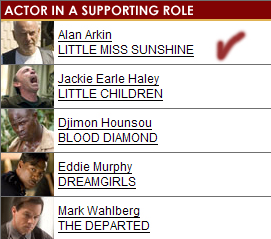
Alan Arkin deserves something for the amazing feat of stealing every scene in which he appears as a horny, heroin-snorting grandfather in Little Miss Sunshine.

Eddie Murphy will probably win, even though he doesn't deserve it. (Interesting side question: does Norbit hurt his chances -- for obvious reasons -- or does it help him because it allows the Academy to send Eddie the message that he should stick to more serious and respectable fare?)

Mark Wahlberg shouldn't have been nominated, although I don't mind him getting belated kudos for Boogie Nights. Ben Affleck, whom I normally abhor, was terrific in Hollywoodland, and should have replaced Marky Mark on the ballot. (Granted, Pearl Harbor was so bad that Affleck should be blacklisted for another decade or so.)


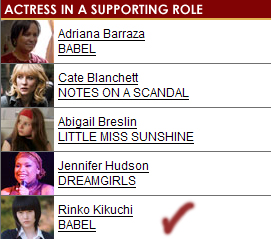
Rinko Kikuchi in Babel delivered one of the best acting performances of any human being in the last five years. Without saying a word. I can't imagine any other person anchoring a movie about global crises in the role of a deaf, volleyball-playing girl in Tokyo so desperate for intimacy that she tries to tongue-kiss her dentist.

Call me a hater but Jennifer Hudson's performance in Dreamgirls amounted to no more than a fantastic night on American Idol. Her voice was amazing, but her acting wasn't even half as good as Shareeka Epps in Half Nelson or Maribel Verdú in Pan's Labyrinth, who both shamefully failed to make the cut.


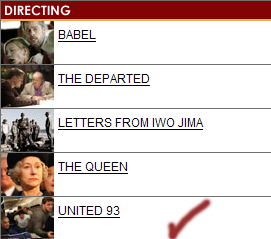
In making the excellent United 93, Paul Greengrass could have exploited a national tragedy and made it into a jingoistic TV movie of the week. He could have made the terrorists one-dimensional movie villains and made the passengers into Hollywood heroes. But he didn't. He didn't even make "Let's roll" into a catchphrase. Instead, Greengrass made what feels like a real-time documentary from the eye of a poet. As I noted in this DVD review, Greengrass' commentary demonstrate how much careful thought and research he put into this painful but exhilarating film.

Scorsese is obviously long overdue, but giving him an Oscar for the mediocre The Departed is almost as ridiculous as giving him an Oscar for directing Michael Jackson's video for "Bad."

Stephen Frears directing a surprisingly entertaining film about a subject in which I have very little interest. But most of that credit should probably go to Helen Mirren, Michael Sheen (a doppelganger for Tony Blair), and the screenplay. Most of the time, I felt like I was watching a really good TV movie of the week, which isn't saying much.

Labels: movies

--Junichi

Permalink | |

Monday, January 22, 2007

QUESTION OF THE WEEK #90


Eyes Without A Face


This Week's Question:

What movie has no chance of getting a Best Picture nomination tomorrow from the Academy, despite your belief that it was one of the best movies of 2006?


FWIW, I'd be willing to bet my underwear that the five best picture nominees will come from the following list of six movies: “Babel,” “The Departed,” “Dreamgirls,” “Little Miss Sunshine,” “The Queen," and “United 93.”

Labels: movies, QOTW

--Junichi

Permalink | |

Who Runs This?

    Most Recent Comments

Previous Posts

  • WOMEN: PUTTING THE "WILD" IN WILD CARD?
  • LEST WE FORGET THE GOP'S TRACK RECORD UP TO NOW
  • MISS AK-47
  • DNC CONVENTION: NIGHT 4
  • JUST FOR THE HELL OF IT
  • DNC CONVENTION: NIGHT 3
  • DNC CONVENTION: NIGHT 2
  • THE BLACK LIST
  • DNC CONVENTION: NIGHT 1
  • McCAIN MILKS THE POW COW

Archives

    December 2004 | April 2005 | May 2005 | June 2005 | July 2005 | August 2005 | September 2005 | October 2005 | November 2005 | December 2005 | January 2006 | February 2006 | March 2006 | April 2006 | May 2006 | June 2006 | July 2006 | August 2006 | September 2006 | October 2006 | November 2006 | December 2006 | January 2007 | February 2007 | March 2007 | April 2007 | May 2007 | June 2007 | July 2007 | August 2007 | September 2007 | October 2007 | November 2007 | December 2007 | January 2008 | February 2008 | March 2008 | April 2008 | May 2008 | June 2008 | July 2008 | August 2008 |

Our Blog Rolls

  • Junichi's Links
  • Oliver's Links

    Poplicks Radio


  • Junichi's Best Songs of 2007 List
  • Junichi's Best Songs of 2006 List

Help Junichi Lose Weight

  • ... and raise money for charity

 Subscribe to Poplicks.


Weblog Commenting by HaloScan.com